
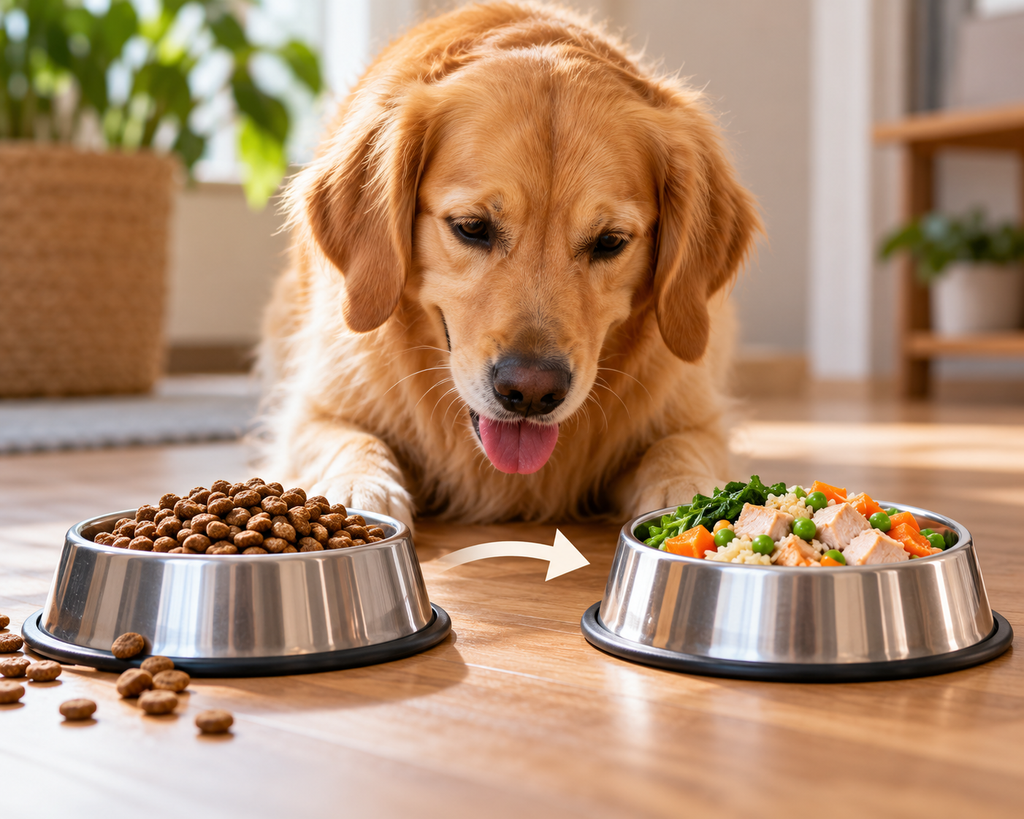
Changing your dog’s food can seem simple: put fresh food in the bowl and stop serving kibble. In reality, that sudden switch can be rough on a dog’s digestive system.
Loose stools, vomiting, reduced appetite, gas, or stomach discomfort are common reasons pet parents become worried after changing diets. The good news is that you usually don’t need to choose between continuing with kibble and making an abrupt change. A gradual transition gives your dog’s digestive system time to adjust.
If you are wondering how to switch your dog from kibble to fresh food, the safest approach is usually to introduce the new food gradually, monitor your dog closely, and avoid making multiple dietary changes at the same time.
How Do I Switch My Dog From Kibble to Fresh Food?
The simplest way to switch dog from kibble to fresh food is to gradually replace the existing kibble with fresh food over several days.
A commonly used approach is:
| Transition stage | Kibble | Fresh food |
| Days 1–2 | 75% | 25% |
| Days 3–4 | 50% | 50% |
| Days 5–6 | 25% | 75% |
| Day 7 onward | 0% | 100% |
These percentages are a general starting point rather than a strict rule. Some dogs may transition comfortably within a week, while others may need more time.
The important thing is to watch your dog’s response rather than rushing through the schedule.
If your dog develops persistent diarrhoea, repeated vomiting, refuses food, seems unusually lethargic, or shows other concerning symptoms, stop progressing with the transition and speak with a veterinarian.
Why Shouldn’t You Suddenly Change Your Dog’s Food?
Can you suddenly change your dog’s food? Technically, a dog may tolerate a sudden change without any obvious problem. But that does not make it the best approach for every dog.
Your dog’s digestive system becomes accustomed to its regular diet. Changing the ingredients, moisture content, fat level, protein sources, and overall composition at once can cause digestive upset.
A gradual kibble to homemade food transition allows your dog’s digestive system to adjust to the new diet.
This is particularly useful for dogs that already have sensitive stomachs or have previously reacted poorly to dietary changes.
How Long Does It Take to Transition Dog Food?
For many dogs, a dog food transition guide of around seven days is a reasonable starting point.
However, there is no universal timeline.
A healthy dog that readily accepts new food may transition without much difficulty. A picky eater or a dog with a sensitive digestive system may need a slower change.
If your dog is doing well at the current ratio, there is no prize for moving to the next stage faster. You can maintain the same ratio for another day or two before increasing the amount of fresh food.
The goal is not to complete the transition as quickly as possible. The goal is to complete it without unnecessarily upsetting your dog’s digestion.
Signs That Your Dog Is Adjusting Well
During the transition, look at more than whether your dog finishes the bowl.
Positive signs can include:
- Normal appetite
- Normal energy levels
- Well-formed stools
- Normal drinking habits
- No repeated vomiting
- No significant digestive discomfort
- Willingness to eat the new food
Your dog’s stool is particularly useful to monitor during a food transition. A mild temporary change may occur as the diet changes, but persistent or severe digestive symptoms should not simply be ignored.
What If My Dog Refuses Fresh Food?
Some dogs immediately investigate a new meal. Others look at it suspiciously and wait for the familiar kibble to return.
Don’t assume that refusal automatically means your dog dislikes fresh food.
The texture, smell, temperature, ingredients, and feeding routine may all be different.
Instead of completely replacing the familiar food overnight, use the gradual transition. Mixing the new food with the existing diet can make the change less dramatic.
Keep the feeding routine consistent as well. Avoid introducing several new treats, supplements, chews, or table foods at the same time. If your dog’s stomach reacts, it becomes much harder to identify what caused the problem.
Is Fresh Food Better Than Kibble for Every Dog?
This is where pet parents should avoid overly simple claims.
Fresh food isn’t automatically the right choice for every dog simply because it sounds more natural. Likewise, kibble isn’t automatically the best option simply because it is convenient.
The bigger question is whether the diet is complete, balanced, appropriate for your dog’s life stage, and suitable for their individual needs.
A fresh diet should not be based on random