
If your dog regularly has loose stools, excessive gas, occasional vomiting, or seems uncomfortable after meals, you may start wondering whether their food is the problem.
Finding the right dog food for sensitive stomach issues isn’t simply about buying a bag labelled “sensitive digestion.” Dogs can react differently to proteins, fat levels, fiber sources, treats, and even sudden changes in their diet.
More importantly, a “sensitive stomach” isn’t a diagnosis by itself. Digestive symptoms can sometimes point to food intolerance, parasites, infections, pancreatitis, inflammatory bowel disease, or other health problems.
So, what should you actually feed a dog with a sensitive stomach?
The answer depends on why your dog’s digestion is sensitive, but choosing a complete, balanced and appropriately digestible diet is a sensible place to start.
What Is a Sensitive Stomach in Dogs?
A sensitive stomach generally refers to recurring or occasional digestive problems such as loose stools, diarrhea, gas, vomiting, or difficulty tolerating dietary changes.
Unlike a specific disease, sensitive digestion describes a pattern of symptoms. That’s why the same food that works beautifully for one dog may cause problems for another.
Common signs include:
- Loose or unusually soft stools
- Excessive gas
- Occasional vomiting
- Changes in appetite
- Constipation
- Difficulty adjusting to new food
- Repeated digestive upset after certain foods
If symptoms are persistent, severe, or accompanied by blood in the stool, repeated vomiting, lethargy, pain, or loss of appetite, don’t assume that changing food will solve the problem. Veterinary assessment is important.
What Makes Good Sensitive Stomach Dog Food?
The best sensitive stomach dog food isn’t necessarily the food with the fewest ingredients or the most expensive ingredients.
Instead, look for a diet that is:
- Complete and balanced for your dog’s life stage
- Highly digestible
- Appropriate in fat content
- Made with protein sources your dog tolerates
- Appropriate in fiber
- Consistent from meal to meal
Veterinary gastrointestinal diets, for example, may be formulated to be highly digestible, lower in fat, higher in fiber, or hypoallergenic depending on the dog’s specific needs.
1. Choose an Easily Digestible Protein
Protein is an important part of your dog’s diet, but some dogs may not tolerate particular protein sources well.
If your dog consistently reacts to a food containing one protein, your veterinarian may recommend trying another protein source or conducting a controlled food trial.
The important part is consistency. If you’re trying to identify a dietary trigger, continuing to give different treats and table scraps makes it much harder to know what’s actually causing the problem.
2. Pay Attention to Fat Content
Fat isn’t inherently bad for dogs. It is an important source of energy.
However, higher-fat foods can be harder for some dogs to digest, particularly dogs with certain gastrointestinal conditions. A lower-fat diet may be better tolerated in conditions such as chronic pancreatitis, but the appropriate diet depends on the individual dog.
Rather than guessing, check the guaranteed analysis on the food label and ask your veterinarian whether your dog’s current fat level is appropriate.
3. Don’t Ignore Fiber
Fiber can play an important role in dog digestion and stool quality.
Some dogs benefit from diets containing specific fiber sources, while others may need a different formulation depending on their digestive condition. Veterinary gastrointestinal diets may use fiber to help support normal gut movement and stool consistency.
This is one reason simply adding large amounts of fiber at home isn’t always the right solution.
4. Look for “Complete and Balanced”
If you’re choosing a commercial food for everyday feeding, nutritional adequacy matters.
A food labelled complete and balanced is formulated to provide the nutrients dogs require in appropriate proportions for the relevant life stage. This is especially important if you’re considering homemade food as a long-term diet.
What Can You Feed a Dog With an Upset Stomach?
For a dog experiencing a mild stomach upset, a veterinarian may recommend a bland, easily digestible diet for a short period.
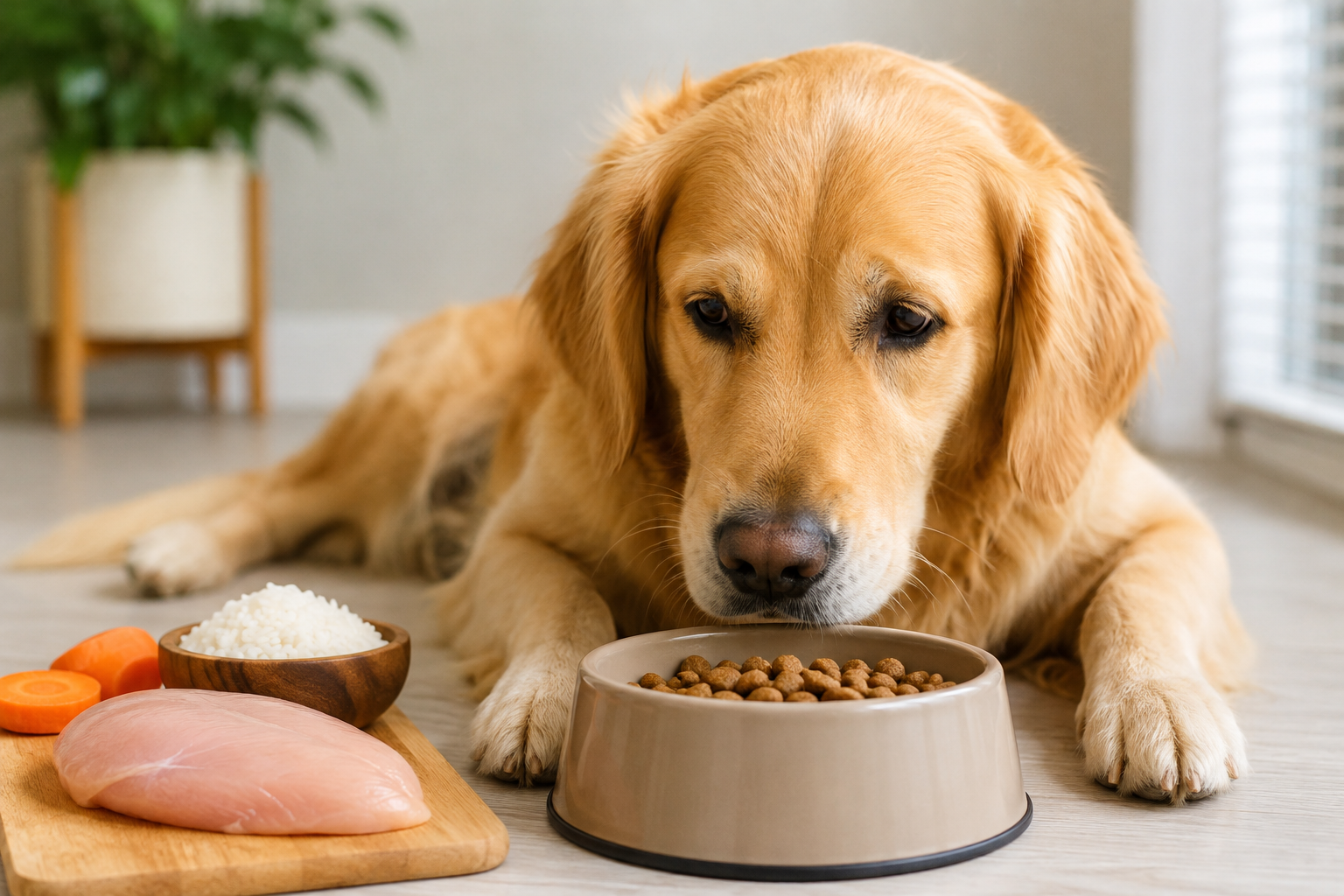
Plain cooked white rice with boiled, skinless chicken is one commonly used example, provided the dog isn’t allergic or intolerant to those ingredients. Food should be prepared without oil, spices, garlic, onion, or rich sauces.
However, there’s an important distinction:
A bland homemade meal is not automatically a nutritionally complete long-term diet.
If your dog needs a special diet for more than a short period, work with your veterinarian or a veterinary nutritionist to ensure nutritional requirements are being met.
Foods to Avoid When Your Dog Has a Sensitive Stomach
When your dog’s digestion is already unsettled, adding rich or unfamiliar foods can make matters worse.
Be particularly cautious with:
- Fatty or heavily processed meats
- Foods cooked with oil
- Spicy or heavily seasoned foods
- Foods containing onion or garlic
- Sudden changes in treats
- Large amounts of table scraps
- Dairy products if your dog doesn’t tolerate them
Processed meats such as bacon, ham, and pepperoni can be particularly rich and salty, while dairy can cause digestive problems in dogs that don’t tolerate lactose well.
The simplest approach during a food trial is often the best: keep the diet controlled and consistent.
How to Change Your Dog’s Food Without Causing More Digestive Problems
One of the most common mistakes owners make is changing food too quickly.
Even a nutritionally appropriate food can cause diarrhea or vomiting if introduced abruptly.
A gradual transition gives your dog’s digestive system time to adjust. One commonly recommended approach is to increase the proportion of the new food over approximately a week:
- Days 1–2: Mostly old food + a small amount of new food
- Days 3–4: Roughly equal amounts
- Days 5–6: Mostly new food
- Day 7: New food completely
Dogs with particularly sensitive digestion may need an even slower transition. Monitor stool quality, appetite, vomiting, and overall behavior throughout the process.
Should You Feed Homemade Food to a Dog With a Sensitive Stomach?
Homemade food can sometimes be useful for short-term digestive upset, but “homemade” doesn’t automatically mean nutritionally complete.
A diet based only on meat and rice, for example, may not provide every vitamin, mineral, fatty acid, and other nutrient your dog needs over the long term.
If you’re considering homemade meals as your dog’s permanent diet, involve your veterinarian or a veterinary nutritionist in the formulation.
When Should You See a Veterinarian?
Don’t keep experimenting with different foods indefinitely if your dog’s digestive problems continue.
Contact your veterinarian if your dog:
- Has repeated vomiting
- Has persistent diarrhea
- Has blood or black, tarry stool
- Appears painful or unusually lethargic
- Stops eating
- Has significant bloating
- Doesn’t improve after a short period of supportive care
Some digestive symptoms that look like simple food sensitivity can have more serious underlying causes.
A veterinarian may recommend diagnostic tests, an elimination diet, a therapeutic gastrointestinal diet, or a hydrolyzed or novel-protein diet depending on the suspected cause.
Frequently Asked Questions
What is the best dog food for a sensitive stomach?
There isn’t one universally best dog food for sensitive stomach problems. The ideal diet depends on your dog’s age, health, symptoms, food tolerance, and the underlying cause of the digestive issue. Highly digestible, complete and balanced diets are commonly considered when managing gastrointestinal problems.
Is chicken and rice good for dogs with sensitive stomachs?
Plain boiled chicken and white rice can be used as a bland, easily digestible meal for some dogs experiencing mild stomach upset. However, it should not automatically become a long-term complete diet, and chicken should be avoided if your dog has an intolerance or allergy to it.
Is wet or dry food better for a sensitive stomach?
Neither is automatically better for every dog. What matters more is the food’s digestibility, nutritional balance, ingredients, fat and fiber profile, and how your individual dog responds to it.
Can changing dog food cause diarrhea?
Yes. An abrupt diet change can cause gastrointestinal upset, including diarrhea, vomiting, and reduced appetite. Transition gradually rather than switching foods overnight.
Should I give my dog treats if they have a sensitive stomach?
If you’re trying to identify a food trigger, temporarily eliminating treats and table scraps can make the food trial more meaningful. Once your dog’s digestion is stable, treats can be reintroduced carefully if appropriate.
What is an easy-to-digest food for dogs?
For mild stomach upset, plain cooked chicken and white rice are commonly used bland-food options when tolerated. Veterinary gastrointestinal diets can also be specifically formulated for high digestibility and may be more appropriate for dogs with ongoing digestive conditions.
The Bottom Line
Choosing dog food for sensitive stomach issues isn’t about finding one magical ingredient.
Start by identifying what your dog is actually reacting to. Choose a complete and balanced, easily digestible diet, pay attention to protein, fat and fiber, avoid unnecessary table scraps, and introduce any new food gradually.
And if digestive problems keep returning, don’t simply keep switching brands. A veterinarian can help determine whether you’re dealing with food sensitivity or something that needs a different kind of treatment.